
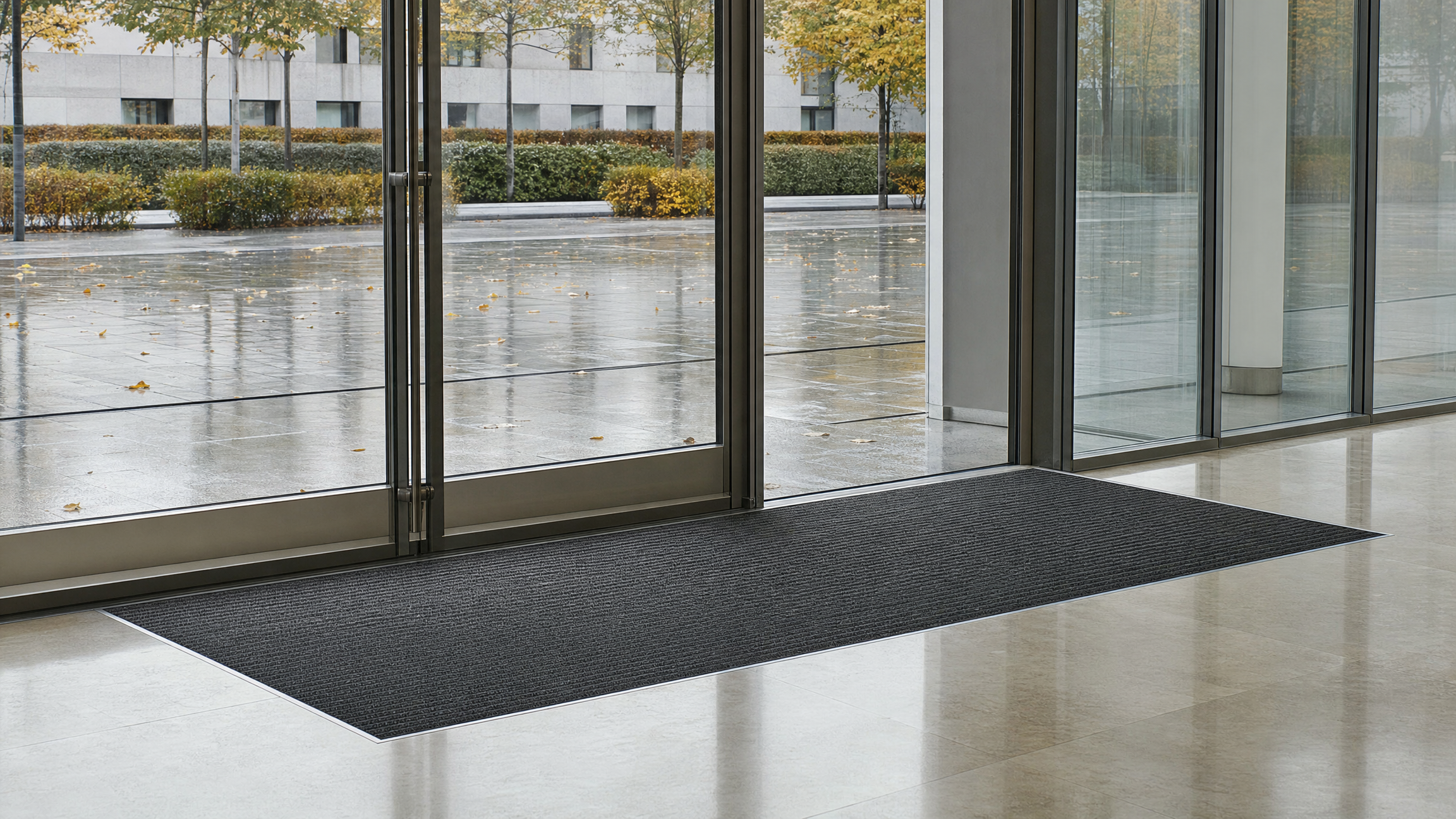
AI illustration
Most of the dirt in a building does not come from inside, it is carried in through the entrances. In autumn and winter especially, shoes bring moisture, grit, leaves and dirt, exactly where the most people pass every day. That costs cleaning time, speeds up wear on floor coverings and increases the risk of slipping at the entrance.
A dirt-trap mat works at precisely this point. It holds dirt and moisture back before they spread through the whole building. This article explains what a dirt-trap mat is, how to choose the right size and type, and how to maintain the mats so they stay effective over time.
What is a dirt-trap mat?
A dirt-trap mat is a multi-zone entrance matting system that captures dirt and moisture from shoes before they reach the inside of the building. Coarse brush or rubber profiles first scrape off solid dirt and water, then textile zones absorb fine dirt and residual moisture. The floor beyond stays clean, dry and safe to walk on.
Depending on the location it is also called barrier matting, an entrance mat or a clean-off zone. Like a lock that controls a passage, the dirt-trap mat separates the dirty outside from the clean inside.
Why a dirt-trap mat pays off for businesses
A good clean-off zone pays off in several ways:
- Less cleaning: whatever stays at the entrance does not have to be wiped up throughout the building. That saves time and cleaning products.
- More slip safety: dry floors reduce the risk of slipping in a busy entrance. For a business, this is also a matter of duty of care towards staff and customers.
- Floor protection: grit and sand act like sandpaper. Stopping them at the entrance extends the life of parquet, stone and hard floors.
- Hygiene and appearance: in hospitals, practices, hotels and catering, a clean, dry entrance is part of the first impression and of hygiene.
In the wet season in particular, when grit and salt are spread outside, the entrance decides how much dirt actually gets in. A clean outdoor area also means less dirt reaches the mat in the first place: to learn how to clean paths and approaches in autumn, read our article on the right pressure washer for autumn.
The three zones of an effective dirt-trap mat
A dirt-trap mat works best when it is arranged in zones:
- Scraping zone (outside): robust brush or rubber profiles loosen coarse dirt, grit and most of the water before the door.
- Transition zone: a combined mat captures fine dirt and slows the remaining moisture.
- Dry zone (inside): a textile mat binds the last moisture so the floor behind stays dry.
Length is decisive: the more steps someone takes across the dirt-trap mat, the more dirt and moisture stay behind. As a rule of thumb, each person should place both feet down several times before reaching the clean floor. For busy entrances the walkway may therefore be several metres long. A mat that is too short has only a limited effect, because the shoe does not get enough contact.
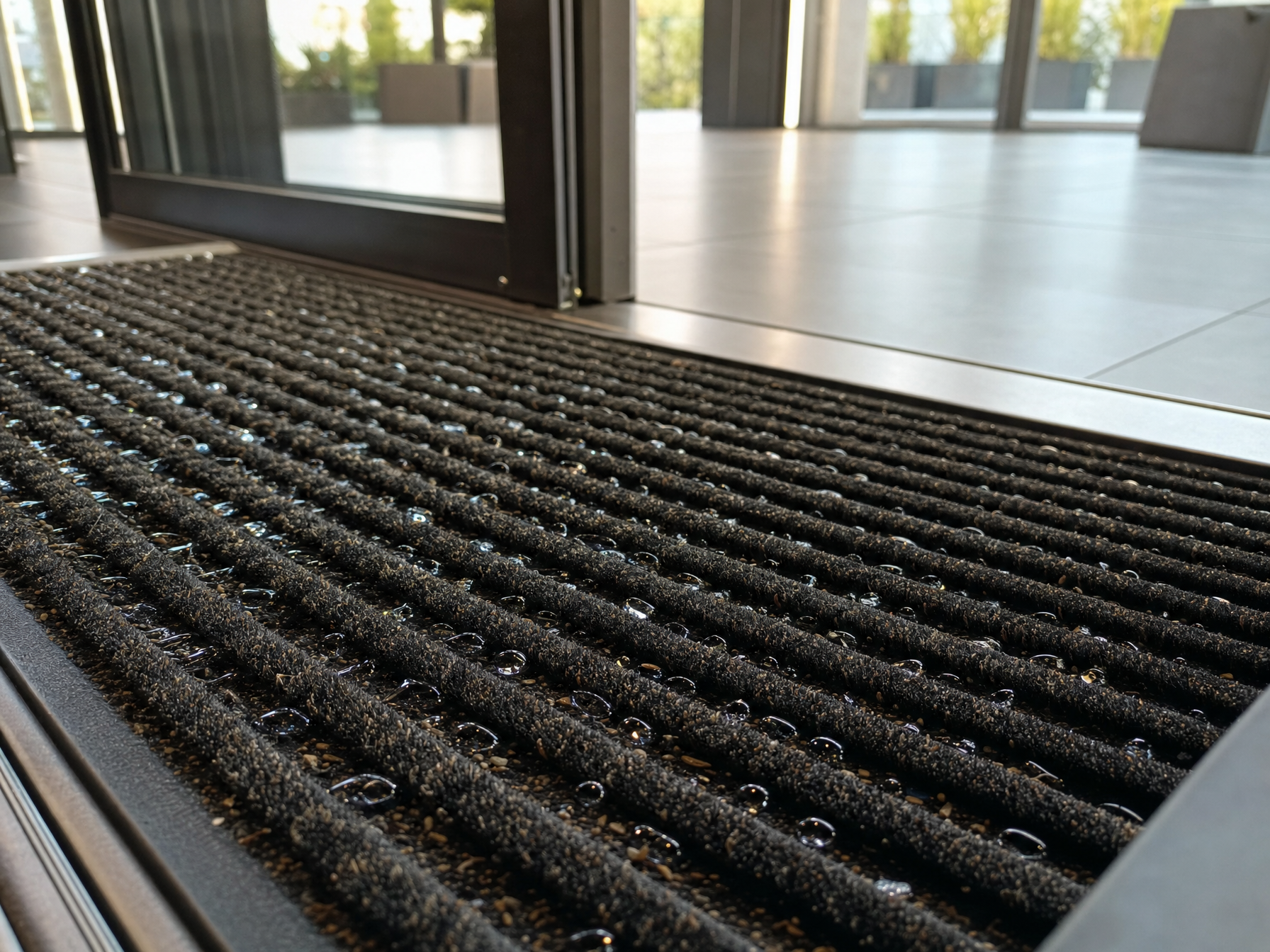
AI illustration
Inside, outside, custom size and logo: the right solution
Which mat suits you depends on the location and the load. In the dirt-trap mat range at Heros Hygiene you will find solutions for indoors and outdoors:
- Classic Brush: robust brush mat for indoors and outdoors, ideal as a first scraping zone for heavy soiling.
- WaterHog: for indoors and outdoors, absorbs water and dirt particularly well and holds both back.
- Classic Solutions: textile mat for indoor use, binds fine dirt and residual moisture.
- Colorstar (logo mat): indoor mat with a freely chosen motif, combining the clean-off zone with a polished brand presence right at the entrance.
The mats come in twelve standard sizes as well as custom cut to size up to 550 cm, with or without a rubber edge. Because size, shape and, for the Colorstar, the motif are individual, the dirt-trap mats have no fixed online price: you simply request a no-obligation quote, and the team matches the model and dimensions to your entrance.
Maintenance: keeping the mat effective
A dirt-trap mat is only as good as its care. A saturated mat no longer holds dirt.
- Vacuum regularly: depending on footfall, daily to several times a week, so sand and dry dirt stay outside.
- Mind the moisture: textile mats need to be able to dry, and a wet mat is better replaced or left to dry out.
- Clean thoroughly: many textile dirt-trap mats can be washed or damp-cleaned. The method and temperature depend on the material, so follow the manufacturer's instructions for each mat.
- Replace in good time: a flattened or frayed mat loses its effect and becomes a trip hazard itself.

AI illustration
Common mistakes
- Too short: a single small mat is rarely enough at a business entrance, the shoe does not get enough contact.
- Wrong type in the wrong place: a purely indoor mat wears out quickly outside, a coarse outdoor mat looks untidy inside.
- Cleaned too rarely: a saturated mat spreads dirt instead of holding it.
- Laid without fixing: without a suitable edge or cut, the mat itself becomes a slip and trip hazard.
Frequently asked questions
What is a dirt-trap mat?
A dirt-trap mat is an entrance matting system that captures dirt and moisture from shoes before they enter the building. Coarse profiles first scrape off solid dirt and water, then textile zones bind fine dirt and residual moisture.
How big should a dirt-trap mat be?
Big enough for a person to take several steps across it before reaching the clean floor. The longer the walkway, the more dirt and moisture stay behind. For heavily used entrances several metres are therefore useful; for small entrances at least a length that takes both feet several times.
Is a dirt-trap mat worth it?
Yes, wherever many people enter a building. It reduces cleaning, protects floors from grit and sand and lowers the risk of slipping at the entrance. For hospitals, hotels, catering and businesses with public footfall it is particularly worthwhile.
How do I clean a dirt-trap mat?
Vacuum regularly so sand and dry dirt do not build up. In addition, wash or damp-clean textile mats when needed, depending on the material and the manufacturer's instructions. Let wet mats dry or replace them so they can absorb moisture again.
Can you wash a dirt-trap mat?
Many textile dirt-trap mats can be washed, but the permitted method and temperature depend on the material. So follow the care instructions for the specific mat. Brush and rubber mats are usually beaten out, hosed down or vacuumed rather than washed.
Conclusion
A dirt-trap mat is one of the simplest measures with a big effect: it holds dirt and moisture back at the entrance, saves cleaning time, protects floors and makes the entrance safer. What matters is the right type for indoors or outdoors, a sufficient length and regular care.
As a Swiss specialist partner for hygiene, cleaning and business supplies based in Diepoldsau in the Rheintal, Heros Hygiene advises you on the right solution, from the robust outdoor mat to the Colorstar logo mat with your motif. Because size and design are individual, the price is on request. Request your no-obligation quote, and we will match the dirt-trap mat to your entrance.


